
A Tetris clone built entirely in R, following the modern guideline
rules: a 7-bag randomizer, SRS rotation with wall kicks, a ghost piece,
hold, lock delay, and gravity that speeds up every ten lines. The
playfield is an integer matrix, so collision checks and line clears are
plain matrix indexing (board[cells],
rowSums()), and every cell on the board is drawn with a
single vectorized draw_rectangle() call. It demonstrates
combining get_key_pressed() for one-shot actions with
is_key_down() for held keys (delayed auto shift and soft
drop), frame-rate independent timing with get_frame_time(),
and fade() for semi-transparent overlays.
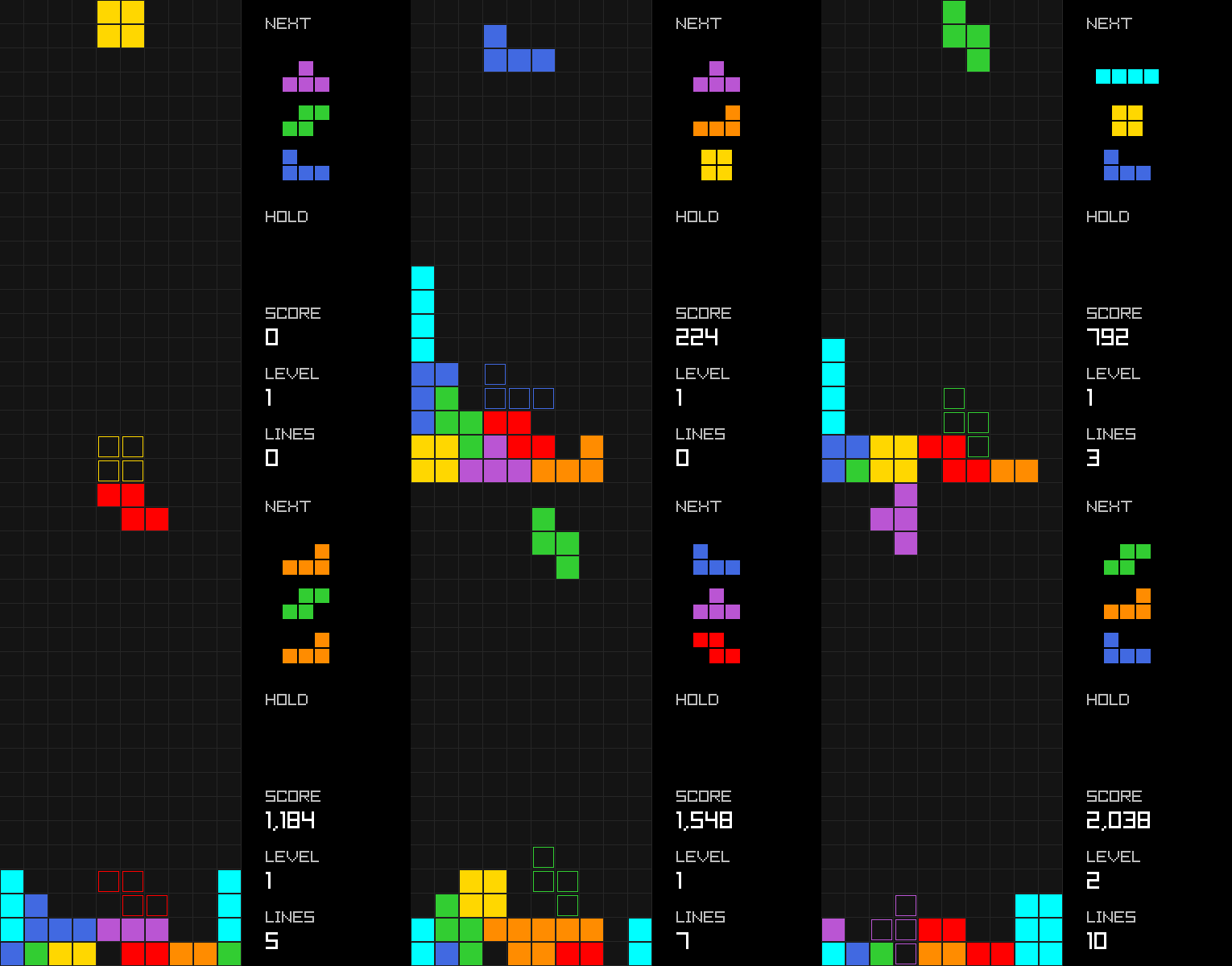
Tetris gameplay
Try it
Click the canvas to focus it.
| Key | Action |
|---|---|
| Left / Right | Move |
| Down | Soft drop |
| Space | Hard drop |
| Up / X | Rotate clockwise |
| Z | Rotate counterclockwise |
| C | Hold |
| P | Pause |
| Enter | Restart after game over |
Run
demo("tetris", package = "raylibr")Source code
library(raylibr)

cols <- 10
rows <- 20
hidden <- 2
scale <- 30
window_size <- c(510, 600)

pieces <- list(
  I = matrix(c(0, 0, 0, 0,
               1, 1, 1, 1,
               0, 0, 0, 0,
               0, 0, 0, 0), 4, byrow = TRUE),
  O = matrix(c(1, 1,
               1, 1), 2, byrow = TRUE),
  T = matrix(c(0, 1, 0,
               1, 1, 1,
               0, 0, 0), 3, byrow = TRUE),
  S = matrix(c(0, 1, 1,
               1, 1, 0,
               0, 0, 0), 3, byrow = TRUE),
  Z = matrix(c(1, 1, 0,
               0, 1, 1,
               0, 0, 0), 3, byrow = TRUE),
  J = matrix(c(1, 0, 0,
               1, 1, 1,
               0, 0, 0), 3, byrow = TRUE),
  L = matrix(c(0, 0, 1,
               1, 1, 1,
               0, 0, 0), 3, byrow = TRUE)
)

piece_colors <- c("cyan", "gold", "mediumorchid", "limegreen",
            "red", "royalblue", "darkorange")

# SRS wall kicks as (x, y) offsets with y pointing up, keyed by "from>to"
kick <- function(...) matrix(c(...), ncol = 2, byrow = TRUE)
kicks_jlstz <- list(
  "0>1" = kick(0, 0, -1, 0, -1,  1, 0, -2, -1, -2),
  "1>0" = kick(0, 0,  1, 0,  1, -1, 0,  2,  1,  2),
  "1>2" = kick(0, 0,  1, 0,  1, -1, 0,  2,  1,  2),
  "2>1" = kick(0, 0, -1, 0, -1,  1, 0, -2, -1, -2),
  "2>3" = kick(0, 0,  1, 0,  1,  1, 0, -2,  1, -2),
  "3>2" = kick(0, 0, -1, 0, -1, -1, 0,  2, -1,  2),
  "3>0" = kick(0, 0, -1, 0, -1, -1, 0,  2, -1,  2),
  "0>3" = kick(0, 0,  1, 0,  1,  1, 0, -2,  1, -2)
)
kicks_i <- list(
  "0>1" = kick(0, 0, -2, 0,  1, 0, -2, -1,  1,  2),
  "1>0" = kick(0, 0,  2, 0, -1, 0,  2,  1, -1, -2),
  "1>2" = kick(0, 0, -1, 0,  2, 0, -1,  2,  2, -1),
  "2>1" = kick(0, 0,  1, 0, -2, 0,  1, -2, -2,  1),
  "2>3" = kick(0, 0,  2, 0, -1, 0,  2,  1, -1, -2),
  "3>2" = kick(0, 0, -2, 0,  1, 0, -2, -1,  1,  2),
  "3>0" = kick(0, 0,  1, 0, -2, 0,  1, -2, -2,  1),
  "0>3" = kick(0, 0, -1, 0,  2, 0, -1,  2,  2, -1)
)

line_points <- c(100, 300, 500, 800)

rotate_cw  <- function(m) t(m[nrow(m):1, , drop = FALSE])
rotate_ccw <- function(m) t(m)[ncol(m):1, , drop = FALSE]

# Board coordinates (row, col) of the cells occupied by a piece
cells <- function(p) {
  rc <- which(p$shape == 1, arr.ind = TRUE)
  cbind(rc[, 1] + p$pos[1] - 1, rc[, 2] + p$pos[2] - 1)
}

fits <- function(p) {
  rc <- cells(p)
  all(rc[, 1] >= 1 & rc[, 1] <= nrow(board) &
      rc[, 2] >= 1 & rc[, 2] <= cols) && all(board[rc] == 0)
}

moved <- function(p, drow, dcol) {
  p$pos <- p$pos + c(drow, dcol)
  p
}

spawn <- function(type) {
  # Put the top of the piece on the first visible row
  shape <- pieces[[type]]
  first <- min(which(rowSums(shape) > 0))
  list(type = type, shape = shape, rot = 0,
       pos = c(hidden + 2 - first, if (ncol(shape) == 2) 5 else 4))
}

next_piece <- function() {
  if (length(queue) < 4) queue <<- c(queue, sample(7))
  type <- queue[1]
  queue <<- queue[-1]
  piece <<- spawn(type)
  can_hold <<- TRUE
  lock_timer <<- 0
  lock_resets <<- 0
  if (!fits(piece)) game_over <<- TRUE
}

try_move <- function(drow, dcol) {
  candidate <- moved(piece, drow, dcol)
  if (!fits(candidate)) return(FALSE)
  piece <<- candidate
  TRUE
}

try_rotate <- function(dir) {
  if (piece$type == 2) return(FALSE)
  to <- (piece$rot + dir) %% 4
  candidate <- piece
  candidate$shape <- if (dir == 1) rotate_cw(piece$shape) else rotate_ccw(piece$shape)
  candidate$rot <- to
  table <- if (piece$type == 1) kicks_i else kicks_jlstz
  offsets <- table[[paste0(piece$rot, ">", to)]]
  for (i in seq_len(nrow(offsets))) {
    kicked <- moved(candidate, -offsets[i, 2], offsets[i, 1])
    if (fits(kicked)) {
      piece <<- kicked
      return(TRUE)
    }
  }
  FALSE
}

# Moving or rotating a resting piece postpones locking, at most 15 times
reset_lock <- function() {
  if (lock_resets < 15) {
    lock_timer <<- 0
    lock_resets <<- lock_resets + 1
  }
}

ghost <- function() {
  g <- piece
  while (fits(moved(g, 1, 0))) g <- moved(g, 1, 0)
  g
}

lock_piece <- function() {
  board[cells(piece)] <<- piece$type
  piece <<- NULL
  clearing <<- which(rowSums(board != 0) == cols)
  if (length(clearing) > 0) {
    clear_timer <<- 0.15
  } else {
    next_piece()
  }
}

clear_lines <- function() {
  n <- length(clearing)
  board <<- rbind(matrix(0L, n, cols), board[-clearing, , drop = FALSE])
  score <<- score + line_points[n] * level
  lines_cleared <<- lines_cleared + n
  level <<- lines_cleared %/% 10 + 1
  clearing <<- integer(0)
  next_piece()
}

hold_piece <- function() {
  if (!can_hold) return()
  type <- piece$type
  if (is.na(held)) {
    next_piece()
  } else {
    piece <<- spawn(held)
    lock_timer <<- 0
    lock_resets <<- 0
    if (!fits(piece)) game_over <<- TRUE
  }
  held <<- type
  can_hold <<- FALSE
}

# Seconds per row, levelling off at level 20
gravity <- function() {
  l <- min(level, 20)
  (0.8 - (l - 1) * 0.007)^(l - 1)
}

new_game <- function() {
  board <<- matrix(0L, rows + hidden, cols)
  queue <<- sample(7)
  held <<- NA
  score <<- 0
  lines_cleared <<- 0
  level <<- 1
  fall_progress <<- 0
  das_dir <<- 0
  das_timer <<- 0
  clearing <<- integer(0)
  clear_timer <<- 0
  game_over <<- FALSE
  paused <<- FALSE
  next_piece()
}

# Drawing ------------------------------------------------------------------

draw_cells <- function(rc, color, x0 = 0, y0 = -hidden * scale, size = scale) {
  if (length(rc) == 0) return()
  draw_rectangle(x0 + (rc[, 2] - 1) * size + 1, y0 + (rc[, 1] - 1) * size + 1,
                 size - 2, size - 2, color)
}

draw_preview <- function(type, x, y, color = piece_colors[type]) {
  shape <- pieces[[type]]
  shape <- shape[rowSums(shape) > 0, colSums(shape) > 0, drop = FALSE]
  size <- 20
  x0 <- x + (4 - ncol(shape)) * size / 2
  y0 <- y + (2 - nrow(shape)) * size / 2
  draw_cells(which(shape == 1, arr.ind = TRUE), color, x0, y0, size)
}

draw_label <- function(text, y, size = 20, color = "gray") {
  draw_text(text, 330, y, size, color)
}

draw_overlay <- function(title, subtitle) {
  draw_rectangle(0, 0, cols * scale, rows * scale, fade("black", 0.8))
  draw_text(title, (cols * scale - measure_text(title, 40)) / 2, 250, 40, "white")
  draw_text(subtitle, (cols * scale - measure_text(subtitle, 20)) / 2, 300, 20, "gray")
}

draw_game <- function() {
  begin_drawing()
  clear_background("black")

  # Playfield
  draw_rectangle(0, 0, cols * scale, rows * scale, "gray8")
  xs <- seq(0, cols * scale, scale)
  ys <- seq(0, rows * scale, scale)
  draw_line(xs, 0, xs, rows * scale, "gray15")
  draw_line(0, ys, cols * scale, ys, "gray15")

  filled <- which(board != 0, arr.ind = TRUE)
  draw_cells(filled, piece_colors[board[filled]])

  if (length(clearing) > 0) {
    draw_cells(cbind(rep(clearing, each = cols), seq_len(cols)), "white")
  }

  if (!is.null(piece)) {
    g <- cells(ghost())
    draw_rectangle_lines((g[, 2] - 1) * scale + 2, (g[, 1] - hidden - 1) * scale + 2,
                         scale - 4, scale - 4, piece_colors[piece$type])
    draw_cells(cells(piece), piece_colors[piece$type])
  }

  # Side panel
  draw_label("NEXT", 20)
  for (i in 1:3) draw_preview(queue[i], 340, 20 + i * 55)
  draw_label("HOLD", 260)
  if (!is.na(held)) draw_preview(held, 340, 300, if (can_hold) piece_colors[held] else "gray30")
  draw_label("SCORE", 380)
  draw_label(format(score, big.mark = ","), 405, 30, "white")
  draw_label("LEVEL", 455)
  draw_label(format(level), 480, 30, "white")
  draw_label("LINES", 530)
  draw_label(format(lines_cleared), 555, 30, "white")

  if (game_over) draw_overlay("GAME OVER", "Press Enter to restart")
  if (paused) draw_overlay("PAUSED", "Press P to continue")

  end_drawing()
}

# Game loop ----------------------------------------------------------------

init_window(window_size[1], window_size[2], "R & Raylib: Tetris")
set_target_fps(60)
new_game()

while (!window_should_close()) {
  dt <- get_frame_time()

  while ((k <- get_key_pressed()) != 0) {
    if (game_over) {
      if (k == key$enter) new_game()
    } else if (k == key$p) {
      paused <- !paused
    } else if (!paused && !is.null(piece)) {
      if (k == key$up || k == key$x) {
        if (try_rotate(1)) reset_lock()
      } else if (k == key$z) {
        if (try_rotate(-1)) reset_lock()
      } else if (k == key$space) {
        while (try_move(1, 0)) score <- score + 2
        lock_piece()
      } else if (k == key$c) {
        hold_piece()
      }
    }
  }

  if (!game_over && !paused && length(clearing) > 0) {
    clear_timer <- clear_timer - dt
    if (clear_timer <= 0) clear_lines()
  }

  if (!game_over && !paused && !is.null(piece)) {
    # Sideways movement with delayed auto shift
    dir <- is_key_down(key$right) - is_key_down(key$left)
    if (dir == 0) {
      das_dir <- 0
    } else if (dir != das_dir) {
      das_dir <- dir
      das_timer <- 0
      if (try_move(0, dir)) reset_lock()
    } else {
      das_timer <- das_timer + dt
      while (das_timer >= 0.17) {
        das_timer <- das_timer - 0.05
        if (try_move(0, dir)) reset_lock()
      }
    }

    # Gravity, twenty times faster while soft dropping. Progress is counted
    # in rows so that switching speed never releases a burst of rows.
    soft_drop <- is_key_down(key$down)
    fall_progress <- fall_progress + dt / (gravity() / if (soft_drop) 20 else 1)
    while (fall_progress >= 1) {
      fall_progress <- fall_progress - 1
      if (try_move(1, 0)) {
        if (soft_drop) score <- score + 1
      } else {
        fall_progress <- 0
      }
    }

    # Lock after resting on the stack for half a second
    if (fits(moved(piece, 1, 0))) {
      lock_timer <- 0
    } else {
      lock_timer <- lock_timer + dt
      if (lock_timer >= 0.5) lock_piece()
    }
  }

  draw_game()
}

close_window()